Showing posts with label Arctic. Show all posts

Wednesday, May 15, 2013

A Changing of the Guard... Outcomes from the 2013 Arctic Council Ministerial Meeting


As the impact of climate change intensifies in the Arctic, and the issues move from a regional to global stage, the Arctic Council faces substantial challenges to ensure a sustainable future for the North. 'Ive been fortunate to attend the Arctic Council ministerial summit in Kiruna, Sweden representing the Advisory Committee for the Protection of the Sea (ACOPS). This meeting sees a transition from Swedish to Canadian leadership of the Council and a new set of priorities and challenges emerge for Arctic governance.

The challenges for the Arctic are environmental, social and economic and are deeply entwined. While this is not new, specific recognition of their inter-related nature is relatively recent. The warning signs are increasingly there… disappearing summer sea ice, acidification of polar seas, shifting patterns of biodiversity as species shift their ranges northwards and habitats change due to climatic stress – all driven by human induced climate change. At the same time the Arctic is ‘open for business’ and while the reality of resource extraction is still in its infancy, the seriousness of the situation and the grave consequences of an oil spill are recognised. The Arctic Council was certainly saying the right words… Senator John Kerry, the US Secretary of State railed against the lack of international and domestic action on climate change and pressed for a global agreement with China…. But can the Arctic Council and its members deliver meaningful action and influence global outcomes?

The tone of the summit today was one where the immense challenges are recognised, and there seems to be real effort in negotiating the issues and moving forward. Don’t forget that this is really quite a difficult thing where eight countries (US, Russia, Canada, Norway, Sweden, Denmark – Greenland, Finland, Iceland) and 6 indigenous permanent members are pushing for their view of a sustainable Arctic. Not to mention the hustle from new observers all vying for their vision of the Arctic.

Today saw some noteworthy outcomes that indicate positive steps. The Ministers signed off on a legally binding agreement on oil pollution preparedness and response. This, while not perfect, will build capacity across the Arctic states to prevent spills from occurring and to coordinate in the case of (a disastrous) spill. There is some way to go to develop this capacity across the region and I’m sympathetic for calls for oil and gas development moratoriums until the regime is firmly in place. However, this is essentially happening in several areas… the US has pulled back from oil exploration off the Alaskan coast, Greenland has put in place new regulations and is limiting exploration, and Norway is exercising a very cautious approach. Russia is the wildcard and it is calling in partnerships from oil and gas companies (e.g. Shell, BP and Dong Energy) to develop the technical capability. However, exploration is risky, technically difficult and overtly expensive – major risks to any project and several (such as the Russian gas development Shtokman) have been delayed by several years.

The Arctic Council appears to be embracing its role as a policy making rather than policy shaping organisation. This was the 2nd legally binding agreement out of the Council (the 1st being a Search and Rescue treaty) and there are moves to develop a task force and agreement on addressing black carbon. This appears to be a sensitive subject with the Russian Foreign minister accused by Russian Association of Indigenous Peoples of the North for delaying progress on the issue. A permanent secretariat now exists in Norway for the Arctic council and there is a clear mandate for the Arctic Council to be more aggressive on the international stage, in particular with a commitment for all Arctic states to work together with other countries for a legal agreement on climate change no later than 2015. Time will tell….

Finally… in a significant development in the history of the council, China, Japan, Korea, India, and Italy have been awarded permanent observer status. The decision on the EU, again, has been delayed to next year, but rumours suggest it will eventually succeed. Although not widely discussed, I also heard Greenpeace was not successful in its application to be an observer. The observer tent is now considerably large – over 300 people attended today – and represents States, non-government  and indigenous groups….a question is will the Council be able to cope with this influx of interests. One thing that appears certain is that the Arctic is now a global issue and spreads beyond the borders of the Arctic states.

Canada now takes over the helm. Its objective is to focus on the human dimensions of the Arctic and improve conditions for indigenous residents, open up economic opportunities, and place indigenous knowledge alongside scientific information in making assessments. The spotlight is firmly on Canada and the Arctic Council to ensure that development does not undermine the ecological or cultural values of the Arctic… summed up beautifully by the Saami Council representative:

‘Energy security is only valid when underpinned by ecological security’.

A valid and insightful comment. More from Sustainable Seas soon. 

Tuesday, April 16, 2013

Blogging from Svalbard: The Arctic in a time of change...

I'm fortunate to be spending this week at the University institute of Svalbard (UNIS - pictured) where I am teaching the undergraduate program on environmental management. It is my 5th trip to Svalbard, a magic part of the word, located remotely 1000 miles north of Norway and parallel to the northern tip of Greenland. It is an amazing place, home to the small settlement of Longyearbyen with a population of 2000 people where I am based for the week. I'm here in the busy tourist season where daily flights bring in hundreds of tourists for polar activities including dog sledging, snow mobile tours, and wildlife watching including polar bears, reindeer, and sea birds. Longyearbyen is also home to a resident international student population (including students from SAMS) at UNIS that teaches different aspects of Arctic polar science.

As I flew in late Sunday night, I saw a snapshot of the sea ice around the archipelago as it begins to fracture and retreat northwards. Miles above the ocean and in the clear Arctic air, you get perspective of the expanse of this region combined with its stunning beauty and fragility. With the recent return of 24 hour daylight the Arctic is thawing and the cycles are moving from winter to spring with the annual retreat of the sea ice  underway. I'm currently at the southern edge of the March distribution and as the sea ice moves through its peak to the summer minimum I wonder what changes this year will bring to the Arctic.

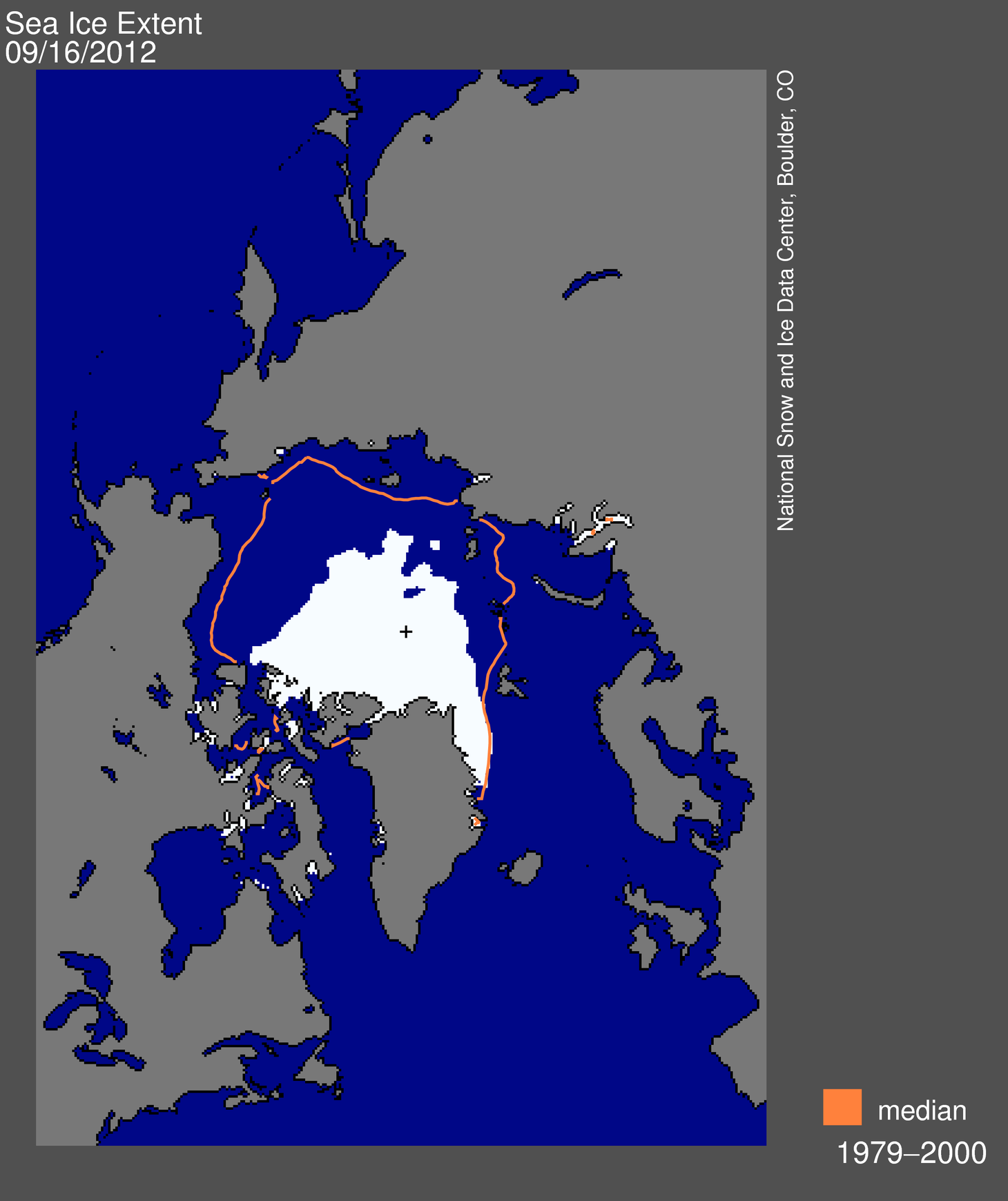
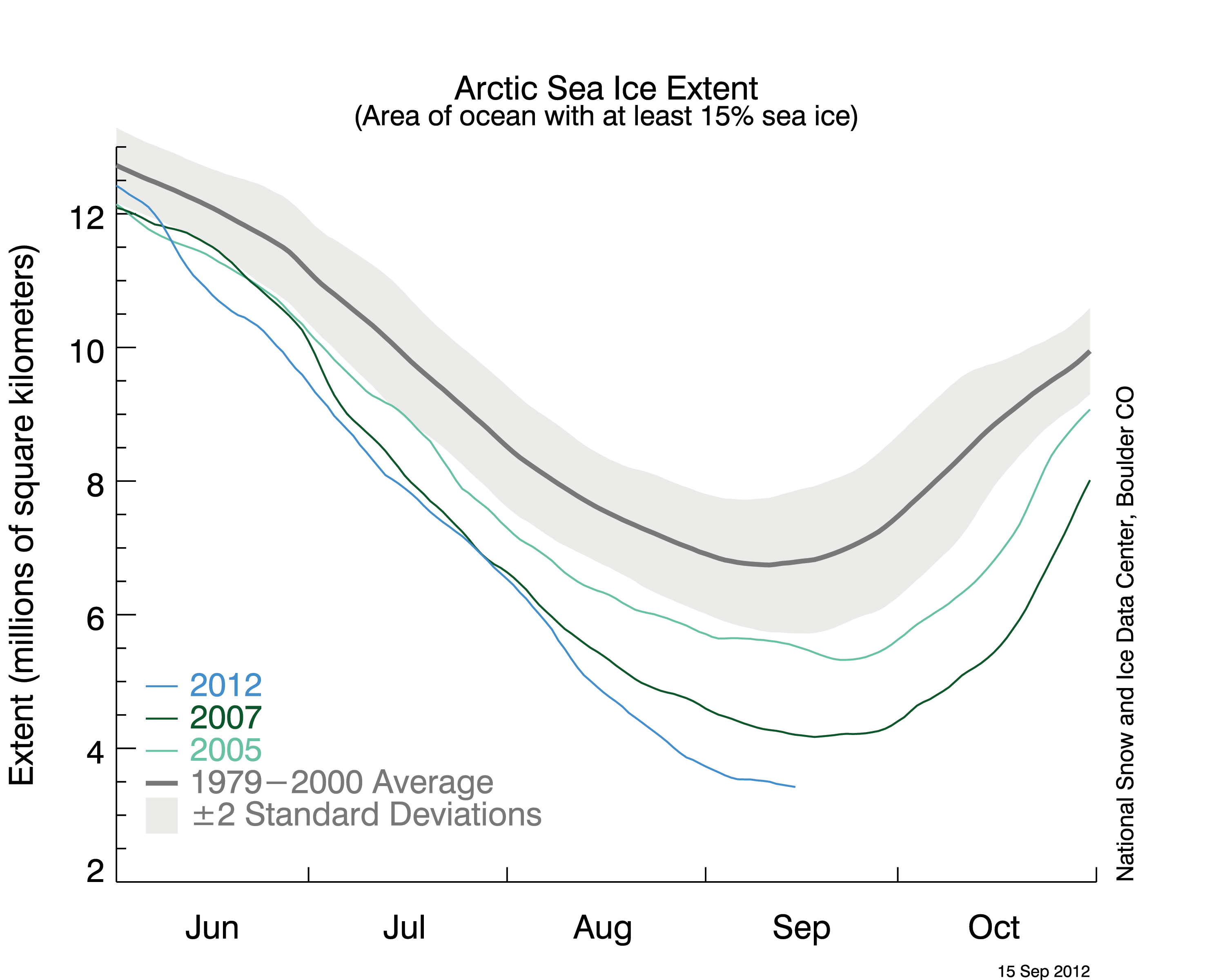
As shown by the National Snow and Ice Data Centre) Arctic Sea Ice update, the region is one of the most rapidly warming places on the planet. CO2 emissions and associated warming is shifting the region into a new and unpredictable territory characterised by huge reductions in summer sea ice extent and thickness, snow cover, and extensive melting of the Greenland ice sheet. Recent reports from the US National Oceanic and Atmospheric Administration (NOAA) Arctic Report Card highlight the concerning trends. 2012 highlighted on ongoing downward trend in summer sea ice, and was itself a new record with the lowest seasonal minimum extent in the satellite record since 1979.

The retreat of the ice is driving a frenzy of political, economic and environmental interest not just from the Arctic States themselves but from the global community. The Arctic is well and truly a global issue, from an international action on curbing CO2 and implementing a low carbon economy, to debates over biodiversity conservation and international shipping. The global economic system inherently affects the Arctic through demands for resources and energy which can stimulate Arctic development or steer away from the inherently risky and expensive operations in ice covered areas. While the Arctic states are responsible for management of the region and ultimately decide over the nature of Arctic development, the international community, and we as citizens have an important role to play in influencing the development path. Over the coming days Ill add some substance to this picture, focusing on the links between the Arctic and the rest of the planet.

Stay tuned to Sustainable Seas.


Tuesday, December 13, 2011

Geoengineering in the Arctic

A recent commentary in New Scientist 'Call for Arctic geoengineering as soon as possible' discusses the perspective that  a climate "tipping point" has been reached in the Arctic and that geoengineering is urgently required to turn around the deterioration of Arctic sea ice. The suggestion is for using stratospheric aerosols to cool the surface and subsurface below, or increasing the reflectance of low-level clouds by pumping a fine spray of salt water into them, and therefore cooling the ocean-atmosphere system. 

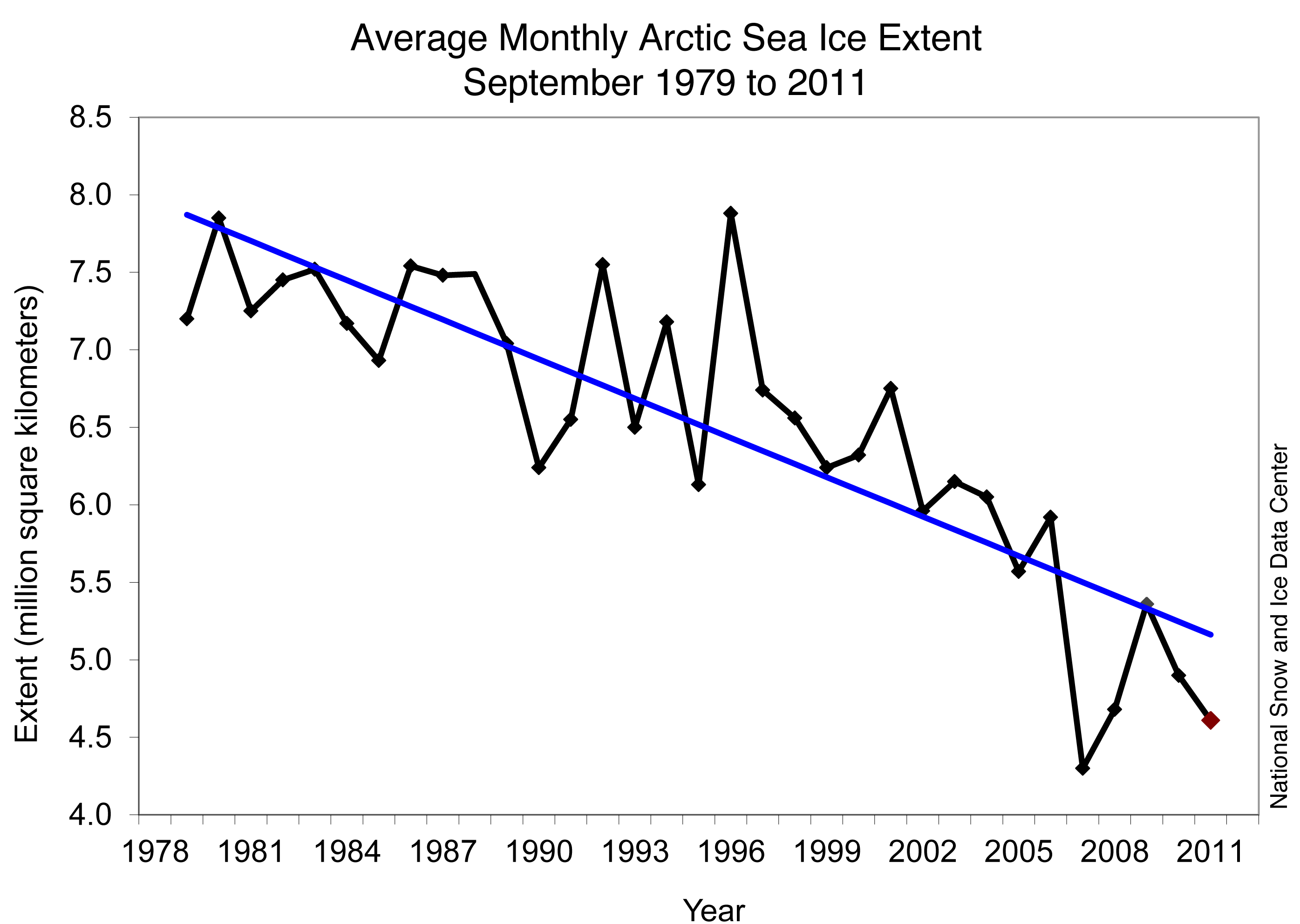
In highlighting the geoengineering solution, there is  an assumption that there is a crisis in Arctic summer sea ice, driven by human influenced climate change. Looking a the past records of summer sea from from the National Snow and Ice Data Centre ice extent for September 2011 was the second lowest in the satellite record. The last five years (2007 to 2011) have had the five lowest September extents in the satellite record with the rate of decline now -84,700 square kilometers (-32,700 square miles) per year, or -12% per decade relative to the 1979 to 2000 average.

Clearly something is going on in the system and the evidence points to human induced climate change from GHG emissions as the key player. Natural variability is still an issue, and this is underpinned by considerable uncertainty about how the system will react in the future to a warming planet and where the tipping points for irreversible change lie. The only clear message is that it is unclear and that human pressures and natural variability have combined to create a state change in the Arctic.

In term of geoengineering, I'm pessimistic about it's application in the region, and more importantly its potential effects. However, despite the uncertainty about the impacts of geoengineering on the marine environment and the hair raising implications of it as a final 'last gasp' solution to climate change, we must still continue to investigate its applications, its impacts and its opportunities. But geoengingeering (at least to me) and as pointed out in a recent Guardian article feels like failure of political process to get agreement of binding international cuts and a failure to turn society around towards a low carbon economy. It is the last straw and one that will hopefully not be required in lieu of poor progress on international action to reduce emissions. 


What is your perspective?